From adjective to evidence
“Waterproof” is not a test method or acceptance criterion.
A label can keep its film intact while its ink rubs away, its adhesive releases, its edge lifts, or its barcode becomes unreliable. The useful brief identifies the complete construction, applied surface, exposure sequence and permitted change.
This guide is the testing companion to the custom waterproof labels service page. Use this page to design and record representative trials; use the commercial page to review the construction and request a quotation.
Free matrix planner
Count applied samples and observations before testing starts.
One exposure sequence may contain several ordered steps. Define only the construction, substrate and sequence combinations needed for the decision.
Planner boundary: this only counts a buyer-defined matrix. It does not set statistical confidence, a standards-compliant sample size, production sampling, exposure conditions, chemical safety, dwell, rub load, cycle count, peel method, barcode grade, acceptance limit, acceleration factor, service life, certification, compliance, cost, MOQ or production approval.
Reddit demand signals
Real failures combine liquid, timing, surface and handling.
Community reports reveal failure language and overlooked variables. They do not validate a material, supplier, coating, home treatment or universal test condition.
The label became unsalvageable when wet
A body-scrub maker discovered that a visually acceptable label did not survive the intended shower environment. “Waterproof” needed to include prolonged wet use and handling.
Read the shower-label discussionCondensation plus rubbing caused release
A bar workflow reported labels falling from chilled bottles when condensation and friction acted together, showing why application timing and a combined handling sequence matter.
Read the cold-bottle discussionA buyer could not confirm toner resistance
A cleaning-industry buyer needed a label that retained identity under water and cleaning agents, but could not infer chemical resistance from the printer or label name.
Read the chemical-resistance questionTest master data
Freeze the applied system before choosing exposure conditions.
A comparison is useful only when the sample identity, substrate and application process are controlled.
Scroll horizontally to view all columns →
| Input | Define | Why it matters |
|---|---|---|
| Label construction | Face, print method, ink or toner, varnish or laminate, adhesive, liner and converting revision. | “Film label” does not identify print protection or adhesive behavior. |
| Substrate | Material, coating, surface energy questions, texture, cleanliness, curve, seam and manufacturing lot. | Adhesive contact can differ between nominally similar containers or finishes. |
| Application | Hand or machine route, temperature, cleaning, drying, pressure or roller, alignment and application date. | Exposure results cannot correct poor or inconsistent initial application. |
| Dwell | Time, temperature and storage before the first exposure; earliest real-use challenge. | Adhesion can develop after application and must be tested at relevant timing. |
| Sample identity | Construction, substrate, sequence, replicate, checkpoint, operator and reference IDs. | Photos and results must trace back to one physical sample and revision. |
| Acceptance | Visual limits, measurements, code checks, destructive methods and decision owner. | Criteria written after seeing results create inconsistent approvals. |
Avery Dennison's adhesive guide distinguishes minimum application temperature, service temperature, surface energy and the time needed to obtain ultimate adhesion. These are construction-specific inputs, not generic values. Review the official adhesive-technology guide and the selected product data sheet.
Exposure architecture
Write the medium, mechanism, sequence and recovery.
Name the actual liquid and handling process. Water alone cannot represent an oily cosmetic, cleaner, sanitizer, seawater, ice slurry or repeated shower cycle.
Scroll horizontally to view all columns →
| Exposure | Control before testing | Inspect or measure |
|---|---|---|
| Splash / spray | Liquid source, volume, spray pattern, angle, duration, repeats and dry interval. | Wetting, edge lift, staining, print change, adhesion and readability. |
| Condensation | Starting and room conditions, humidity, cycles, dwell, wet handling and recovery. | Edge moisture, bubbles, whitening, sliding, wet rub and post-dry condition. |
| Immersion / shower | Medium, depth or flow, temperature, time, agitation, orientation, cycles and recovery. | Attachment, swelling, wrinkling, tearing, ink or coating loss and residue. |
| Oil / product contact | Named formulation or representative medium, amount, contact location, time, temperature and wipe. | Staining, softening, migration, adhesive change, edge lift, gloss and legibility. |
| Cleaner / chemical | Exact product, concentration, safety controls, contact or wipe method, time, repeats and rinse. | Ink transfer, color, coating, face, adhesive, code and substrate interaction. |
| Wet or dry rub | Cloth or contact material, liquid state, load or method, stroke, speed, cycles and area. | Print or coating loss, scuff, tear, code contrast and remaining information. |
| Temperature cycle | Cold and hot points, ramp, hold, moisture state, cycles, handling and recovery. | Flagging, shrinkage, cracking, sliding, adhesive ooze and post-cycle adhesion. |
| Outdoor weathering | Natural or accelerated route, location or apparatus, orientation, duration and intervals. | Color, gloss, cracking, face and adhesive condition; no unsupported life conversion. |
Separate versus combined sequences
Use isolated challenges to diagnose and combined challenges to reproduce use.
- Baseline firstPhotograph and inspect the applied sample before exposure using the same lighting and measurement method.
- Isolate when diagnosingSeparate water, oil, cleaner, rub and temperature routes help identify which challenge changes the system.
- Combine when representativeCondensation followed by wet rubbing may answer a real bottle-handling question better than either step alone.
- Control recoveryState whether inspection occurs wet, immediately after removal, after a fixed recovery, after drying, or at several checkpoints.
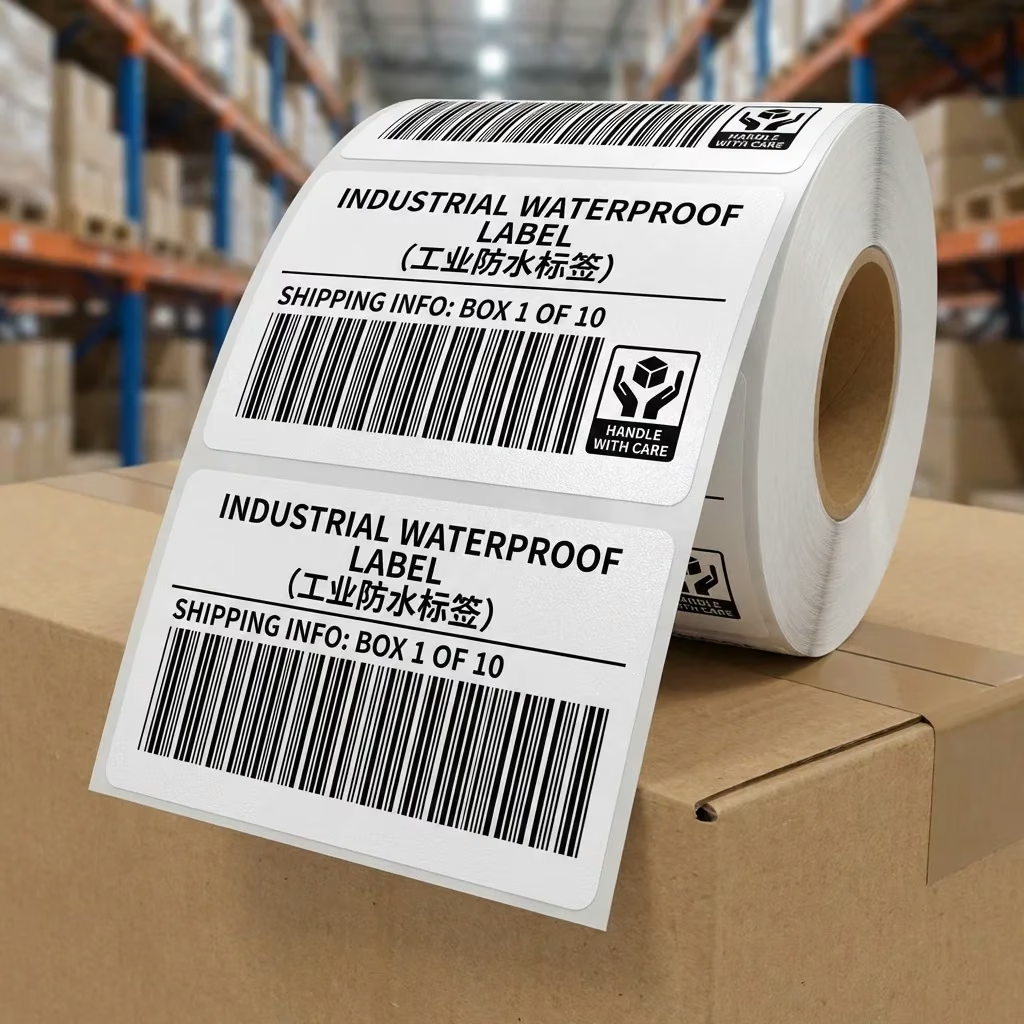

Information and barcode survival
Passing adhesion does not prove the information still works.
Inspect required text, symbols and codes before and after each designated challenge. Define the data owner, symbology, size, print method, verifier or scanner, grade or functional rule, orientation, distance and software system when applicable.
- Keep a verified baseline tied to the sample ID
- Record wrinkles, abrasion, liquid film and distortion that change scanning
- Test applied codes on representative surfaces and curvature
- Distinguish a phone scan from formal verification or system acceptance
- Disposition every failed or unreadable record before release
For transparent films and white backgrounds under codes, also use the clear-label white-ink artwork guide.
Standards boundary
Select a current method for the decision—not a standard number for decoration.
The buyer, converter, laboratory and compliance owner should confirm applicability, current revision, specimens, apparatus, conditioning, calculations and acceptance criteria.
ASTM D6252/D6252M
ASTM describes a 90-degree peel method for pressure-sensitive label stock and notes that representative proposed substrates may replace the standard panel. It measures a defined property; it does not explain every real-world failure.
Review the ASTM scopeASTM D6688
ASTM describes a relative liquid-chemical resistance practice for printed matter and calls for a reference print at the same time to reduce environmental and process variation.
Review the ASTM practiceASTM D7932
This specification addresses printed pressure-sensitive labels for extreme distribution environments, including physical properties, appearance, procedures, reporting and acceptance. It is not automatically required for an ordinary consumer label.
Review the ASTM specificationASTM's label and tape committee also lists separate methods for abrasion of printed materials, low-temperature adherence, weathering, peel and sustained shear. A project may need one method, several methods or a representative use protocol; the list does not itself establish acceptance.
Predeclared acceptance
Describe both the defect and the limit.
“Looks good” cannot support a repeat order. Tie each result to an observable or measured rule and named decision owner.
Scroll horizontally to view all columns →
| Characteristic | Possible record | Decision boundary |
|---|---|---|
| Edge condition | Maximum lift distance, affected edge length, number of lifted locations and photo scale. | Define permitted change by checkpoint and orientation. |
| Attachment | Visual movement, peel result or other selected method at a stated time and condition. | Use a qualified method and limit relevant to the substrate and use. |
| Print / coating | Transfer, smear, abrasion area, color or gloss change and required-text integrity. | Identify what information and appearance must remain. |
| Face material | Swelling, wrinkle, bubble, crack, tear, whitening, shrinkage or distortion. | Set visible and functional limits before exposure. |
| Barcode / code | Verifier result, system scan, contrast or defect record at each required checkpoint. | Named data and quality owner approves the rule. |
| Residue / removability | Adhesive transfer, staining, clean removal or permanence result when relevant. | Define whether removal, permanence or tamper evidence is intended. |
Release and repeatability
Keep the passing sample connected to production.
Changes after a successful trial can invalidate the evidence even when the finished label looks similar.
Freeze risks and criteria
Identify substrates, application, dwell, sequences, controls, checkpoints, destructive tests and pass rules.
Build traceable samples
Assign every construction, substrate, exposure and replicate a unique record and retain suitable references.
Control and document
Record actual conditions, deviations, observations, measurements, photos, failures and responsible operators.
Approve scope and changes
Tie the selected construction to artwork, roll specification, production inspection and requalification triggers.
Require impact review when the face, ink, protection, adhesive, liner, converter, press route, substrate, application, exposure, acceptance rule or required code changes.
Buyer questions
Waterproof label testing FAQ.
Final methods and limits depend on the actual construction, surface, use, risk, market and any named customer or regulatory requirement.