Short answer
A board grade is not a complete shipping box specification.
A usable brief starts with what the case must carry and where it must travel. It records the product and inner pack, finished inside and outside dimensions, case style, units and gross weight per case, board construction and performance evidence, closure, labels, pallet pattern, climate, handling, test method, acceptance criteria, and revision.
The supplier should then return an approved drawing, material and finished-case data, tolerances, sample route, test plan, export packing, pallet information, inspection points, quotation scope, and every assumption. This lets competing suppliers quote the same job instead of attaching different meanings to “double wall,” “heavy duty,” or “export box.”
Keep the product box and master carton separate. The retail or presentation pack protects and communicates at unit level. The corrugated shipping case groups and protects those units through handling. If one package performs both roles, say so explicitly.
Free planning tool
Case cube and simple pallet planner.
Enter finished outside case dimensions, case pack, gross weight, and the available rectangular pallet load space. The tool compares two same-orientation patterns and returns a planning count—not an approved pallet design.
Use finished external case dimensions. The calculator assumes millimetres, kilograms, and cubic metres. “Available load height” excludes the pallet itself.
Voice of the buyer
Community questions start at the shipment system, not the flute name.
Reddit is used here to identify recurring buyer language. Community comments are not structural data, carrier rules, or project approval.
- There is no universal master-carton sizeA packaging-design discussion asks for a standard inner and master carton. The useful answers point back to product size, weight, pallet planning, retailer requirements, and case pack. Read the discussion.
- Small dimension changes can change the billAn ecommerce seller reports a material charge change after a small measurement difference moved the parcel into another volumetric bracket. Use the final packed case and the carrier's current method. Read the discussion.
- Declared data must match the shipped packageA 2026 seller thread focuses on whether listing dimensions can differ from the final package. The practical signal is to measure the actual package used for the shipment. Read the discussion.
- “Stronger” is not a complete protection planCommunity discussions about crushed boxes often skip restraint, voids, closure, humidity, and route hazards. Treat the complete packed product as the test item, not the corrugated sheet alone.
System boundary
Freeze five connected levels before requesting a final quote.
A revision at one level can change the dimensions, loading, labels, compression exposure, case count, pallet count, and freight data at every level above it.
Scroll horizontally to view all columns →
| Level | Data to freeze | Why it changes the case | Evidence |
|---|---|---|---|
| Product | Maximum dimensions, weight, variation, orientation, fragile zones, surface sensitivity. | Controls load, clearance, restraint, pressure points, and damage acceptance. | Drawing, representative product, weight record. |
| Unit and inner pack | Retail pack, tray, divider, wrap, cushioning, count, loading order. | Creates the actual object array carried by the shipping case. | Approved packed sample and pack-out instruction. |
| Shipping case | Style, inside and outside L × W × H, units, gross weight, board, joint, closure, print. | Defines case cube, handling surface, compression geometry, and supplier output. | Drawing, board specification, finished sample, inspection record. |
| Unit load | Pallet, cases per layer, layers, pattern, total height and weight, edge condition, restraint. | Changes load sharing, stability, warehouse fit, and handling equipment compatibility. | Pattern drawing, photographed trial load, verified dimensions and weight. |
| Distribution | Parcel or freight route, handling sequence, climate, storage time, stack, vehicle or container constraints. | Defines the hazards and the correct test and acceptance brief. | Logistics requirements, current carrier or customer rules, agreed test plan. |
Dimension chain
Label every dimension by state and purpose.
Do not exchange a bare “400 × 300 × 250 mm.” Record whether it is a product, cavity, finished inside case, finished outside case, flat blank, or loaded pallet dimension.
- State the order as length × width × height and define which panel is called length
- Record millimetres or inches, measurement method, rounding rule, and tolerance
- Use finished inside dimensions for the approved product and inner-pack fit
- Use maximum finished outside dimensions for cube, labels, conveyors, parcel data, and pallet planning
- Re-measure a conditioned, filled, closed case if bulge or closure changes the maximum extent
Style and construction
Use a drawing or code, then define the details the code does not settle.
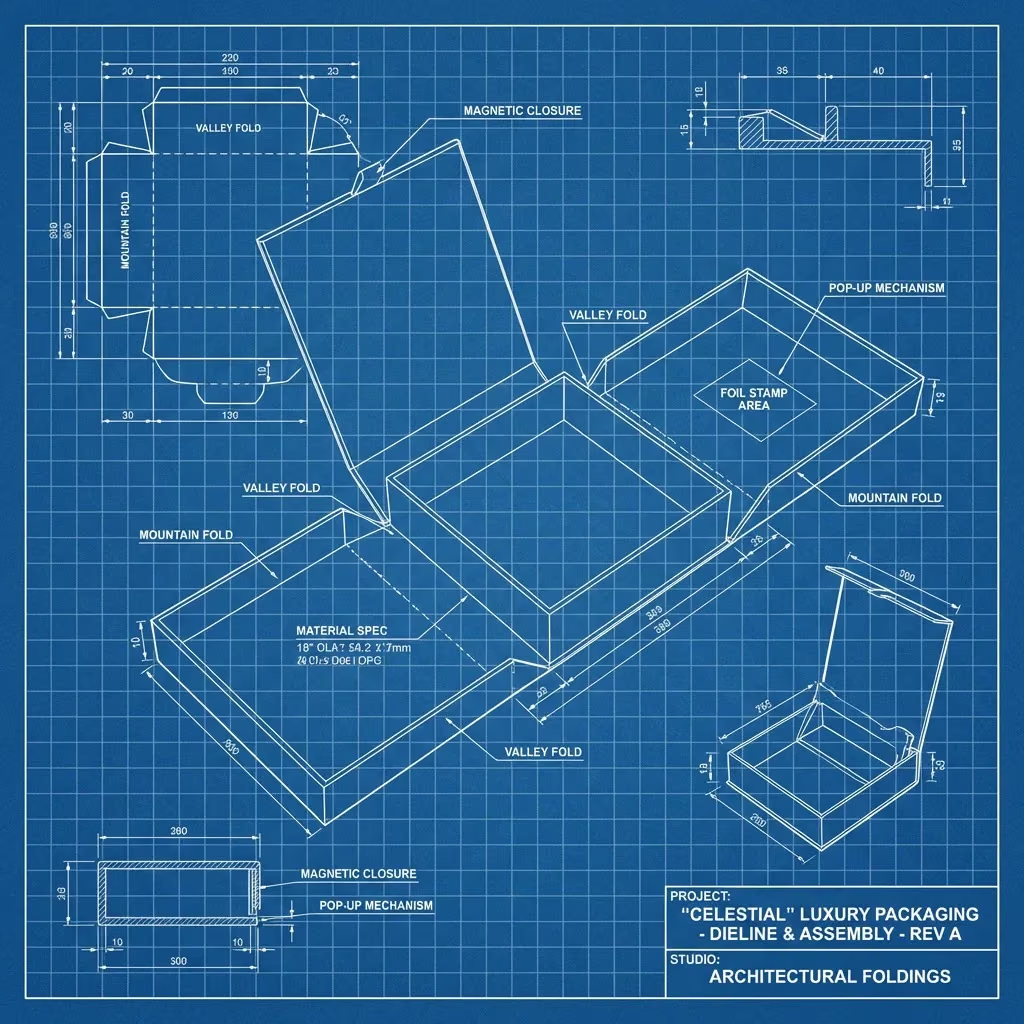
FEFCO describes its code as an internationally applied system for common corrugated designs. A style reference improves communication, but the production drawing remains the project control.
Case geometry and erection
State the FEFCO or other agreed style, flap arrangement, joint location, hand holes, perforations, opening, erection method, and final closure. Review the official FEFCO code overview.
Material plus performance evidence
Record wall construction, flute or caliper, liners and medium or agreed grade convention, surface treatment, recycled-content or restricted-substance requirements, test method, units, sampling, and acceptance limits.
Scores, joint, print, and closure
Control score position, slot and flap geometry, manufacturer's joint, adhesive or stitch route, print zones, barcodes, tape, glue, staples, and closure equipment on the intended board.
Do not convert ECT, burst, and BCT by a universal shortcut. They describe different tests or system responses. The Fibre Box Association publishes separate ECT guidance for stacking applications, while the finished case and packed product still require project-specific review. Review the FBA guide description.
Board evidence
Separate material properties from finished-case performance.
A comparable quotation states what is measured, on which sample, after which conditioning, by which method, in which units, and against which acceptance rule.
Scroll horizontally to view all columns →
| Evidence layer | What it can support | What it cannot prove alone |
|---|---|---|
| Component or combined board data | Material identity and defined board test results under stated conditions. | Finished case compression, closure, pallet stability, or product protection. |
| Finished empty case | Dimensions, scores, squareness, joint, print, closure interface, and defined case tests. | Protection of the real product through an unknown route. |
| Filled case trial | Pack-out fit, restraint, closure, gross weight, handling, bulge, and initial stack behavior. | All distribution hazards or long-term performance without an agreed method. |
| Packaged-product test | Performance of the representative complete system against the selected sequence and acceptance criteria. | Untested variants, changed materials, changed loads, or every real-world event. |
| Production inspection | Whether sampled production matches agreed dimensions, material records, workmanship, print, closure, and packing. | Automatic approval after an uncontrolled specification change. |
Pallet and parcel boundary
Use the calculator to find questions, not to approve the load.
The simple result helps expose whether the proposed case footprint and case pack create an obvious cube or pallet conflict. The next step is a real pattern drawing and representative load.
- Confirm pallet type, deck condition, allowed overhang or underhang, and handling equipment
- Check actual maximum closed-case dimensions, bulge, gross weight, center of mass, and layer interfaces
- Review column or interlocked pattern, gaps, edge alignment, top load, slip sheets, corner protection, straps, and stretch wrap
- Verify total pallet height and weight against the warehouse, truck, container, carrier, retailer, and destination rules
- For parcel shipments, use the current carrier's measurement, rounding, size, weight, and dimensional-weight rules
UPS, for example, defines dimensional weight as occupied space relative to actual weight and instructs shippers to measure the finished package; the applicable limits and divisor can vary by service and agreement.
Review the current UPS guideTest and change control
Approve the complete packed product, then protect the approved state.
ISTA states that its procedures apply to a specific packaged-product system rather than certifying an individual packaging material. Select the current procedure and acceptance criteria with qualified parties for the actual distribution route.
Write the distribution brief
Identify product variant, complete pack, gross weight, route, handling, climate, stack or pallet state, conditioning, hazards, sample quantity, procedure, sequence, and pass/fail criteria.
Record the sample and result
Photograph setup and damage, record sample identity and preconditioning, document each event, inspect product and package after the sequence, and retain the report with the approved specification.
Control every significant change
Reassess product, count, weight, dimensions, board, source, joint, closure, inner pack, pallet, route, climate, or process changes before treating the previous evidence as transferable.
Review ISTA's packaged-product testing overview · Use the ecommerce transit-test briefing guide
Comparable RFQ
Ask every supplier to return the same controlled fields.
A defensible comparison separates buyer inputs, supplier proposal, approval evidence, commercial scope, and change control.
Scroll horizontally to view all columns →
| Section | Buyer states | Supplier returns |
|---|---|---|
| Pack and role | Product, unit pack, inner pack, count, weight, orientation, consumer pack or outer shipper. | Proposed pack-out, clearances, inside dimensions, load concerns, sample assumptions. |
| Case construction | Required style or use, opening, hand holes, closure, printing, labels, restricted substances. | FEFCO or drawing, finished outside dimensions, tolerances, board build, joint, closure and artwork areas. |
| Performance | Stack, humidity, route, hazards, customer requirements, test and acceptance brief. | Material and finished-case evidence, conditioning, test methods, units, limits, sample and report plan. |
| Pallet and logistics | Pallet, maximum load height and weight, warehouse, vehicle, container or parcel constraints. | Cases per layer, layers, total unit-load size and weight, pattern, restraint, cartons and pallets per order. |
| Quality control | Critical dimensions, workmanship, print, labels, closure, packing, defect and sampling expectations. | Inspection plan, production records, traceability, nonconformance route, retained sample and change notification. |
| Commercial scope | Quantity, variants, destination, named Incoterm and place, target in-hand date. | Tooling, samples, unit price, packing, pallet, test, inspection, freight scope, exclusions, validity and lead-time assumptions. |
Corrugated shipping box specification FAQ
Questions to settle before supplier comparison.
These answers define the limits of the planning tool and the evidence required for final approval.