Folded support with defined tabs
Platforms, bridges, collars, and compartments can be cut and folded from board. Useful when presentation, efficient flat supply, and a fiber-led material system matter.
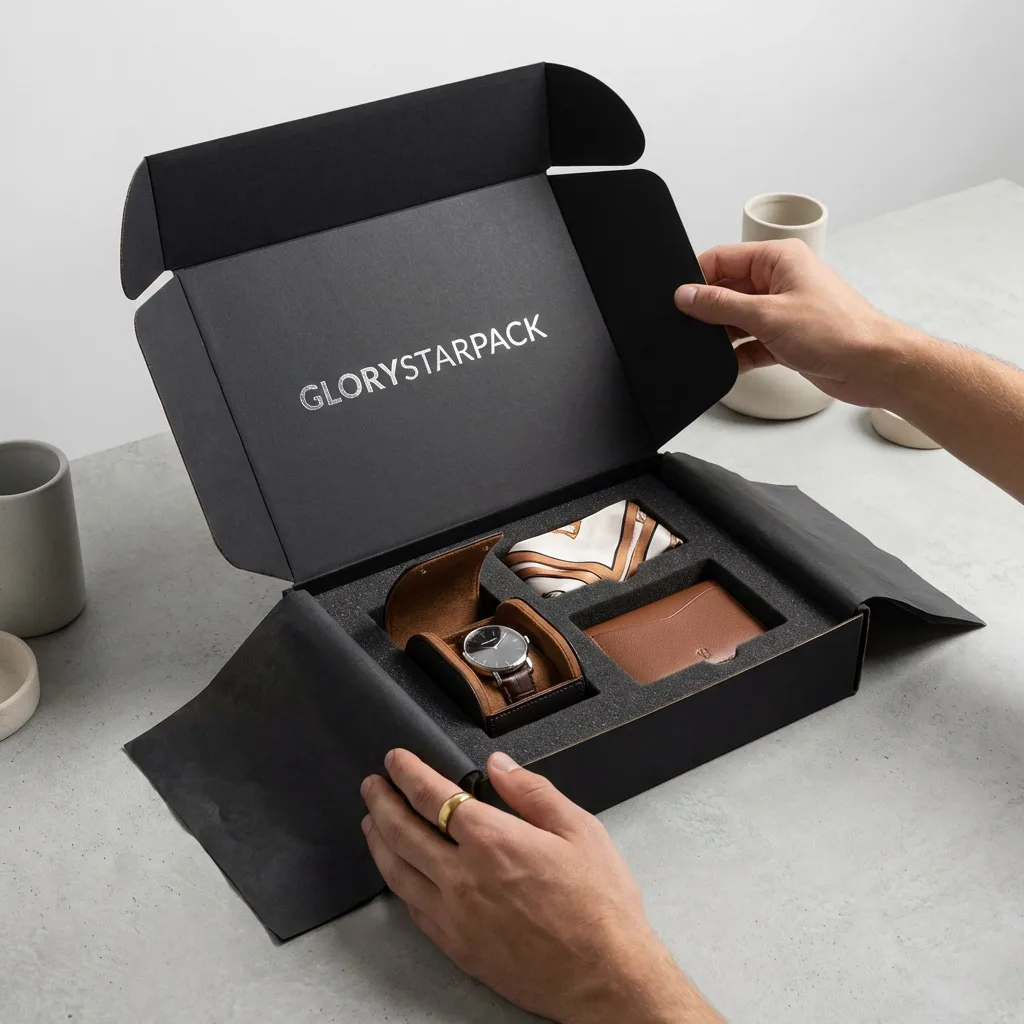
Product-fit trays and cavities
Select material only after the real product, retention points, opening sequence, outer box, separation goal, and transit risks are defined.
Insert material matrix
Material names do not predict performance on their own. Density, thickness, grade, surface, forming method, adhesives, and the outer box are part of the specification.
Planning a ring, earring, necklace, or watch insert? Use the jewelry fit and contact guide
Platforms, bridges, collars, and compartments can be cut and folded from board. Useful when presentation, efficient flat supply, and a fiber-led material system matter.
Formed pulp can cradle three-dimensional products, but draft angles, radii, wall thickness, surface texture, tooling, and available grades constrain fine geometry.
EVA can provide crisp cut edges, layered depths, and controlled presentation. Density, color, odor, surface contact, adhesive, and disposal route require project review.
EPE can be considered where light weight, recovery, and shock cushioning matter. Thickness, density, lamination, cut quality, appearance, and specialist recovery options vary.
Fabric can wrap paperboard or foam for a finished interior. Seams, edge turns, fraying, color, adhesive, product contact, and component separation need explicit approval.
Material availability: density, color, fiber grade, fabric, coating, and documented content are confirmed for the quoted project. A reference photo is not a material specification.
Compare paperboard, molded pulp, EVA, and EPE insert tradeoffs before selecting the sample route.
Product data package
A nominal size is rarely enough. The insert must account for production variation, mass, vulnerable surfaces, accessories, orientation, and how the user removes each item.
Scroll horizontally to view all columns →
| Product input | What to provide | Insert consequence |
|---|---|---|
| Geometry | Production-equivalent samples or controlled 2D/3D data with maximum dimensions and tolerances. | Sets cavity envelope, retention datums, wall thickness, cut paths, and surrounding clearance. |
| Mass | Actual packed weight, center of gravity, concentrated loads, and parts that can shift. | Changes support area, material density, base thickness, bridges, and outer-box loading. |
| Sensitive zones | Fragile projections, pumps, lenses, screens, seals, decorated surfaces, and no-contact areas. | Defines where the insert may restrain, where it must clear, and how pressure is redirected. |
| Presentation | Opening direction, product angle, visible faces, accessory order, documentation, and photography needs. | Sets cavity orientation, reveal height, layering, finger access, and removal sequence. |
| Pack-out | Manual or line packing, product insertion direction, protective bags, labels, and inspection steps. | Changes cavity access, flex points, assembly order, loose-part control, and line ergonomics. |
| Outer pack | Finished internal box dimensions, board structure, closure, master carton, and delivery route. | Controls the insert boundary, compression transfer, movement, and available protective depth. |

Cavity and removal
A cavity should locate the product at controlled datums and resist movement in the expected directions. It should not pinch decorative surfaces, load fragile projections, or require unsafe force to remove the item.
See bottle support for wine boxes · See glass fragrance bottle support · Use the perfume insert fit and approval checklist
Separation and recycling brief
An insert is not automatically recyclable because it looks like paper or carries a familiar polymer name. Coatings, adhesive, fabric, labels, contamination, local collection, and the user's ability to separate components affect the outcome.
Drop and transit brief
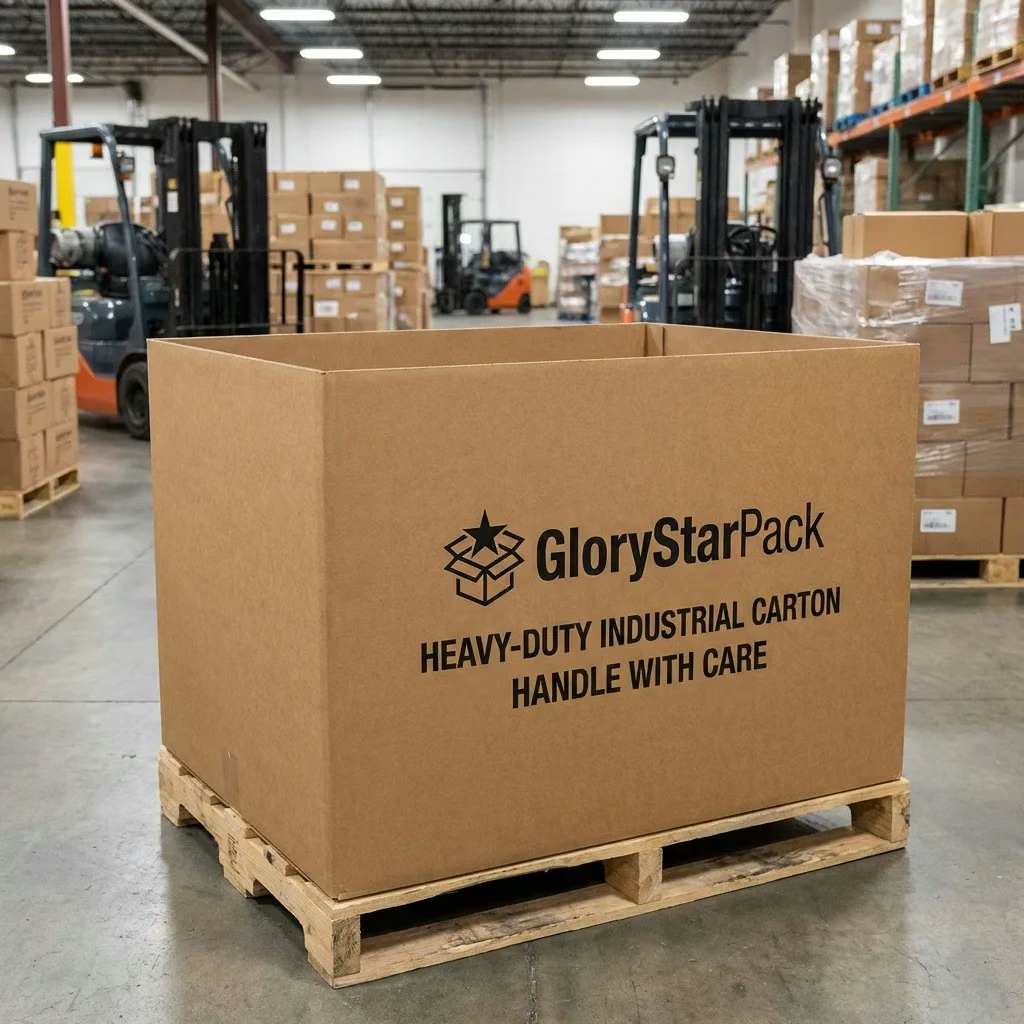
A parcel shipment, palletized retail delivery, and presentation kit carried by hand expose the insert to different loads. Formal testing is useful only when the method, conditioning, sample count, orientation, and acceptance criteria are agreed.
Tolerance stack
A cavity can be correct in CAD and wrong in production if product, insert, box, and assembly tolerances are treated as one fixed number.
Use maximum and minimum production dimensions, not only one ideal sample. Include labels, coatings, bags, cables, and closure positions that alter the envelope.
Die cutting, creasing, pulp forming, foam cutting, laminating, wrapping, and adhesive each create different variation and edge behavior.
Outer-box internal size, insert position, glue, compression, hand assembly, and pack-out direction can shift the final cavity relative to the lid and product.
Approval rule: use production-equivalent products in a physical sample, record the approved support and removal behavior, and retain a signed reference for the production QC brief.
Sample to production
Development timing depends on product data, material availability, tooling, sample revisions, outer packaging, quantity, and any agreed evaluation method.
Confirm geometry, weight, fragile zones, orientation, outer box, route, material limits, and quantity.
Set datums, retention, removal, material, wall or fold geometry, accessories, and pack-out sequence.
Pack production-equivalent products and check movement, contact, removal, outer-box closure, and agreed risks.
Inspect material, dimensions, cavity, adhesion or folds, placement, count, fit sampling, and protective packing.
Insert QC brief
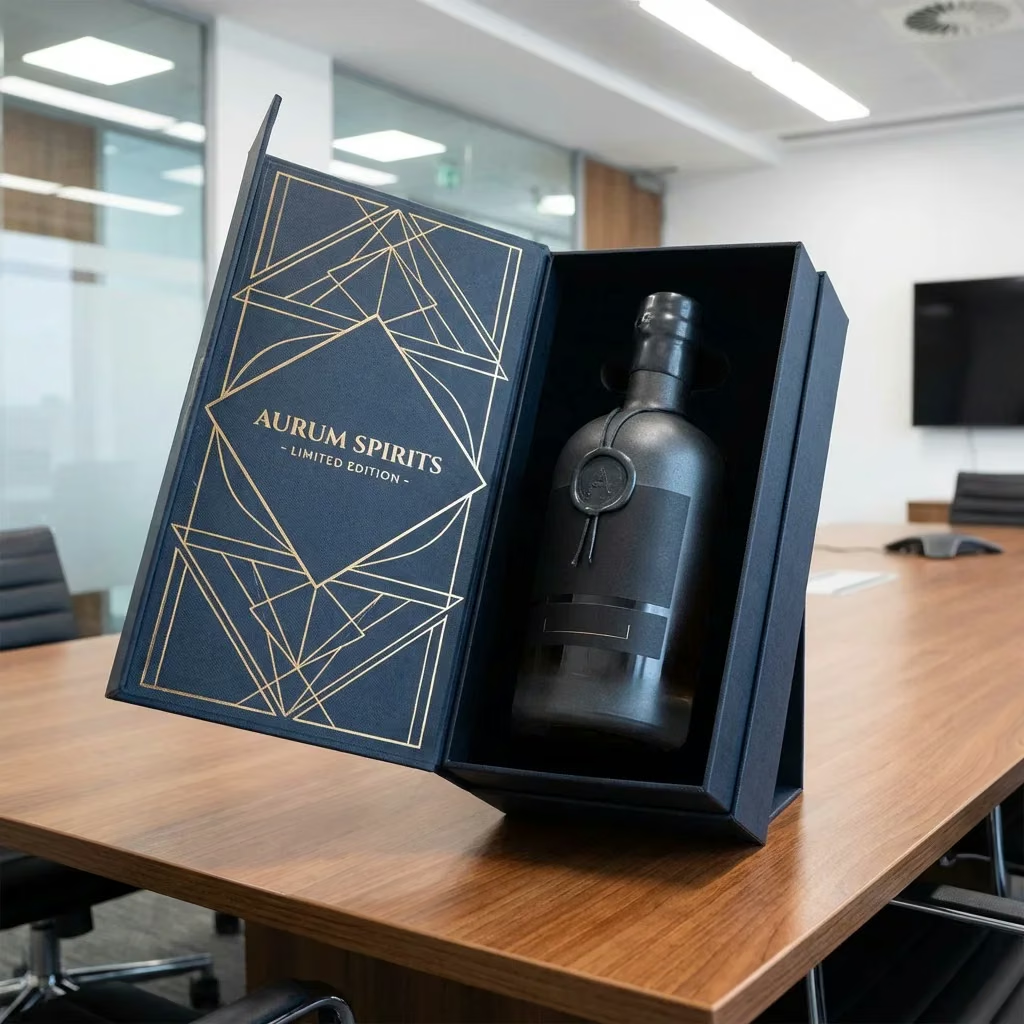
Visual quality matters, but a production insert also needs to locate, retain, release, and present the product consistently inside the approved outer package.
For paperboard inserts, use the caliper and GSM specification guide to keep dimensional thickness separate from material weight and finished performance.
Packaging insert questions
Buyer evidence pack
A logo on a website is not enough. For a material, compliance, or quality requirement, request the current document and verify that its scope applies to your order.
Company identity. GloryStarPack is operated by Xiamen GloryStar Packaging Co., Ltd. in Xiamen, Fujian, China. This site covers custom boxes, bags, inserts, and labels. Visit our specialist glass bottle and container packaging site. View our Alibaba company profile.
Approved photos, dimensions, finish location, and revision notes.
Named substrate, board, adhesive, laminate, or requested certificate copy.
Agreed photos or video from printing, finishing, assembly, and inspection.
Carton count, marks, packing photos, gross dimensions, and delivery term.
Use the packaging sample approval checklist to record fit, color, finishing, pack-out, revisions, and the exact reference that will govern production.
For first production through shipment release, use the packaging quality inspection checklist and record planner to control lots, defects, carton data, corrective action, reinspection, and authority.
Quote a custom packaging insert
Send product dimensions, tolerance, weight, quantity, outer-box details, preferred material, removal direction, and transit route. The reply will identify the fit data still needed.