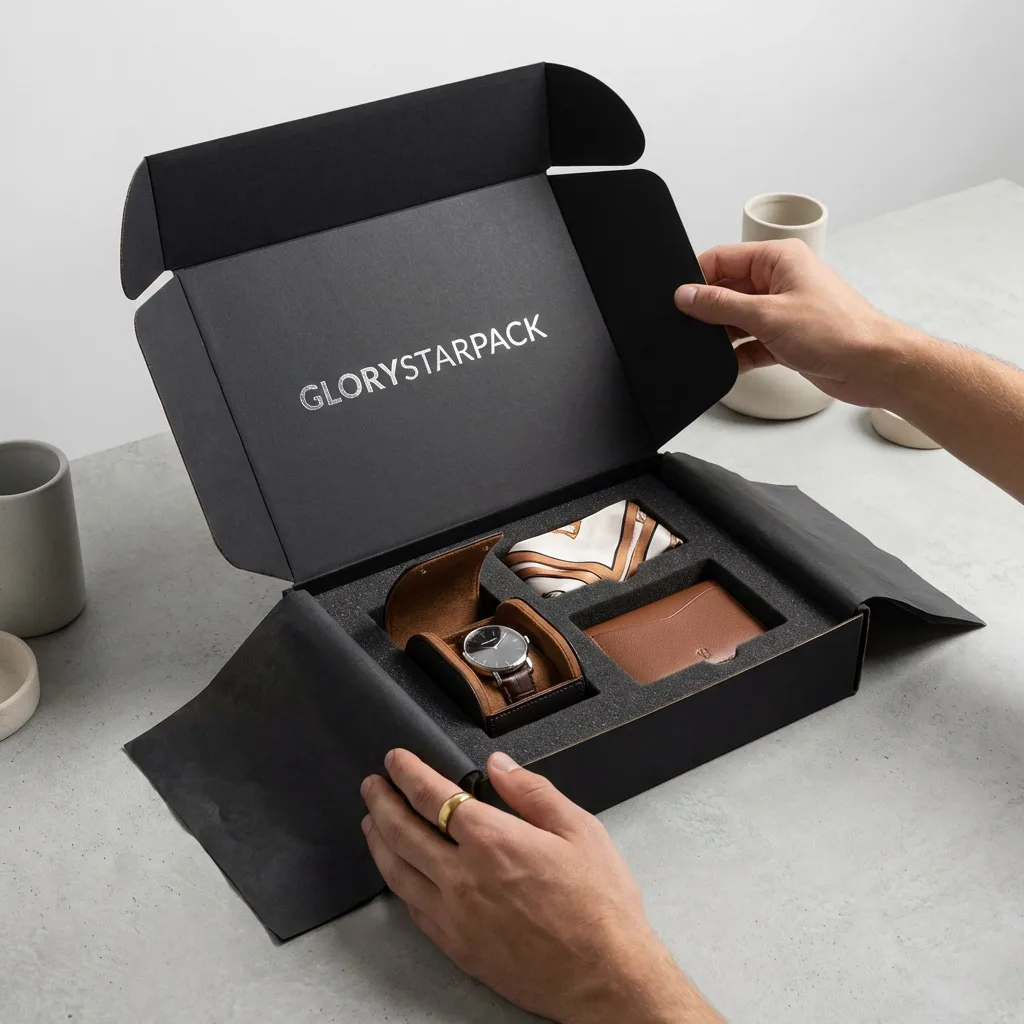
Short answer
Choose the insert from the load path and user path—not from one material claim.
Start with the maximum product envelope, packed weight, center of gravity, fragile and no-contact areas, required orientation, removal movement, accessories, outer-box structure, pack-out process, delivery route, and end-of-use goal. Then compare custom packaging insert materials against the same controlled brief.
Die-cut paperboard is useful for folded platforms, collars, bridges, and compartments. Molded pulp forms a three-dimensional fiber cradle within draft, radius, wall, and surface constraints. EVA can create crisp layered presentation cavities. EPE can provide light, resilient cushioning. None of these descriptions proves product protection by itself.
Compare a system, not a loose tray. Test the production-equivalent product, insert, outer box, individual protection, master carton, packing orientation, and relevant transit conditions together.
Side-by-side
Each material solves geometry in a different way.
The matrix is a shortlist, not a pass/fail result. Exact grade, density, thickness, forming route, adhesive, coating, and surface must be identified in the quotation and sample.
Scroll horizontally to view all columns →
| Decision | Paperboard | Molded pulp | EVA / EPE foam |
|---|---|---|---|
| Geometry | Cut, scored, folded, locked, and assembled into platforms, collars, dividers, and compartments. | Formed around three-dimensional cavities with draft, radii, wall, flange, and tooling constraints. | Cut or layered into cavities; EVA often supports crisper presentation while EPE often supports lighter resilient cushioning. |
| Product contact | Edges, folds, tabs, coatings, and printed surfaces require review around sensitive finishes. | Surface texture, fibers, dust, moisture response, and contact points depend on grade and forming. | Density, odor, color transfer, abrasion, adhesive, plasticizer or chemical compatibility, and surface pressure require review. |
| Removal | Finger notches, lift tabs, ribbons, flexible bridges, and opening folds can create access. | Finger wells, cavity relief, flexible regions, and product projection must be formed into the geometry. | Finger cuts, layered depths, ribbons, and controlled compression can provide access, but tight cavities may trap the product. |
| Presentation | Supports clean folded planes, printed board, compartments, and coordinated fiber-led interiors. | Offers a formed, often visibly fibrous appearance with surface detail limited by the process and grade. | EVA can provide crisp finished cavities; EPE usually prioritizes cushioning over a dense presentation surface. |
| Production inputs | Dieline, board, grain, crease, print, coating, cutting, folding, locking, gluing, and assembly. | Tooling, pulp grade, forming, drying, wall distribution, draft, radius, trimming, nesting, and moisture control. | Density, thickness, layer build, cutting, lamination, adhesive, surface finish, color, and cavity tolerance. |
| End of use | May fit fiber recovery when coatings, adhesives, labels, contamination, and local collection are compatible. | May fit fiber recovery when the exact grade, additives, contamination, and local collection are compatible. | Often requires separate or specialist recovery; availability depends on the exact polymer, construction, cleanliness, and destination system. |
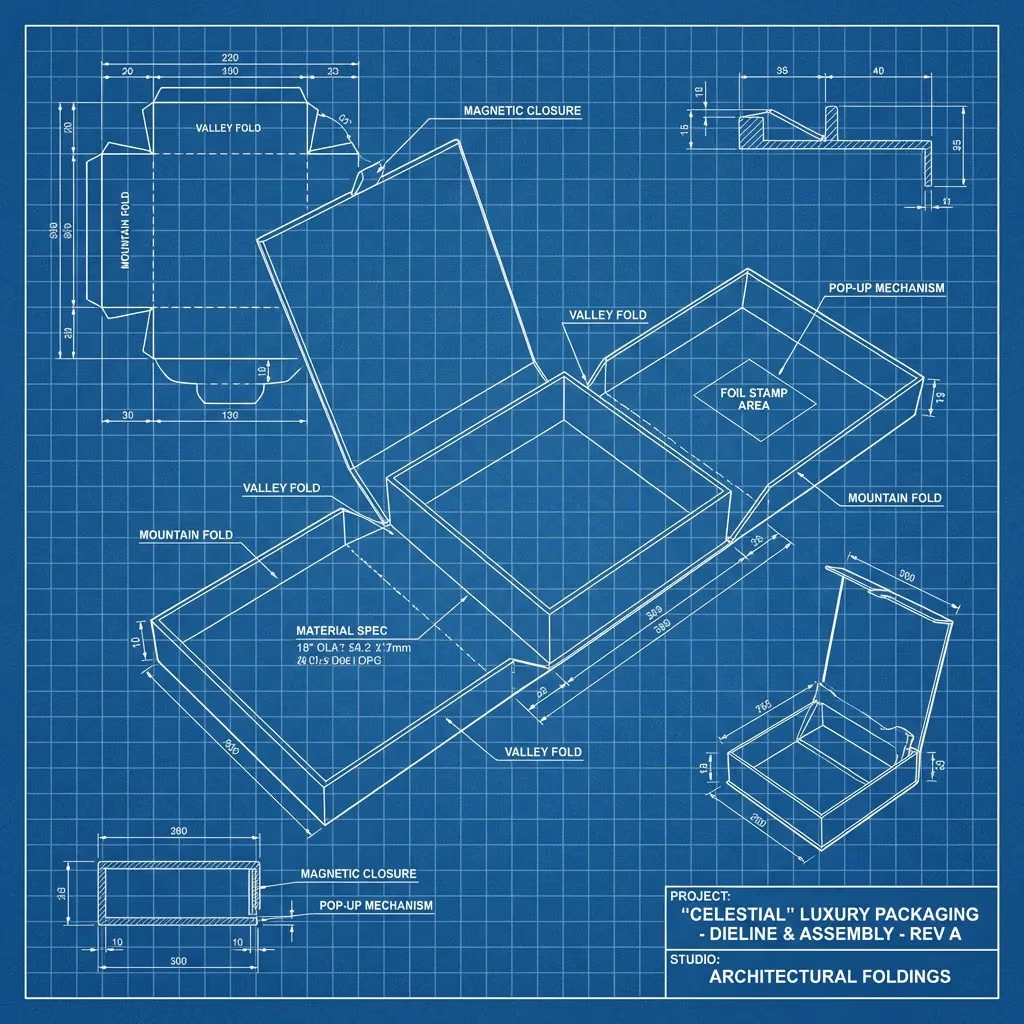
Die-cut paperboard
Use folds and datums to create support with fewer material families.
Paperboard inserts can create raised platforms, collars, bridges, retention tabs, accessory wells, dividers, and documentation compartments. They are most useful when the product can be supported by controlled folded geometry without unsafe pressure or excessive empty structure.
- Set grain, crease, fold direction, tab behavior, and assembly sequence
- Keep cut edges, tabs, print, and coatings away from sensitive product surfaces
- Check whether the insert ships flat, pre-assembled, or is erected during pack-out
- Approve product retention and user removal after repeated assembly and handling
One fiber-led structure can simplify separation, but recyclability still depends on the exact board, coating, adhesive, labels, contamination, and destination collection.
Molded pulp
Use formed geometry when a fiber cradle fits the product.
Molded pulp can locate a three-dimensional object through walls, ribs, pockets, flanges, and relief areas. The shape must respect draft angles, radii, material distribution, forming, drying, release, trimming, nesting, and the surface available from the selected process and grade.
- Allow draft and radii instead of copying a sharp foam cavity directly
- Distribute load through robust product areas and clear fragile projections
- Review surface texture, fibers, dust, moisture conditions, and cosmetic contact
- Confirm nesting, storage, carton count, tooling, and production-equivalent sample route
A formed fiber insert can replace foam only when the loaded system proves fit and protection for the agreed application.
EVA and EPE foam
Separate presentation cavities from cushioning behavior.
“Foam” is not one specification. Polymer, density, thickness, color, layer build, cut method, lamination, surface, odor, recovery, and product compatibility must be defined.
Crisp layered presentation
EVA may be selected for controlled cavity edges, layered depths, a denser feel, and a clean display. Check compression, surface contact, odor, color, adhesive, lining, and removal.
Light resilient cushioning
EPE may be considered when recovery and shock cushioning matter. Check density, thickness, lamination, edge finish, migration, appearance, carton pressure, and recovery options.
A finished surface adds interfaces
Fabric or paper wrapping may change appearance and contact, but also adds seams, turns, adhesive, fraying, thickness, tolerance, mixed-material separation, and production control.
Selection logic
Let the product eliminate unsuitable options first.
A material choice becomes useful when it is connected to an observable product, packing, user, and delivery requirement.
Scroll horizontally to view all columns →
| Priority | Ask | Evidence to approve |
|---|---|---|
| Retention | Which robust surfaces can locate the product, and in which directions must movement be controlled? | Loaded sample after intended handling, orientation, and relevant transit checks. |
| Surface protection | Which decorated, polished, coated, sealed, optical, or fragile areas must not carry pressure or abrasion? | Production-equivalent product after insertion, storage, repeated removal, and environmental exposure if relevant. |
| Removal | Where do fingers enter, what lifts first, and how much force or flexibility is acceptable? | User removal trial with the final product bag, label, accessories, and opening direction. |
| Pack-out | Who assembles the insert, how is the product loaded, and which loose parts must remain controlled? | Timed line or manual packing trial using the intended instructions and inspection steps. |
| Delivery | Is the route parcel, pallet, retail replenishment, or another controlled handling environment? | Agreed drop, vibration, compression, climate, storage, or route-specific checks with defined pass criteria. |
| End of use | Can components be identified and separated, and which collection systems exist at the destination? | Material documentation, construction review, separation trial, and destination-specific claim approval. |

Sample and test plan
Compare evidence from the same product and outer box.
- Use production-equivalent products across their maximum dimensional range
- Record insertion, datum contact, retention, removal, accessory movement, and visible presentation
- Check the insert after storage, repeated handling, outer-box closure, and carton pressure
- Run only the transit and environmental checks relevant to the agreed product, route, and pass criteria
- Keep the approved sample, material specification, drawings, revision, photos, and test record together
Use the packaging sample approval checklist to record what each prototype proves before material substitution or bulk release.
Cost and sourcing
Quote tooling, conversion, packing, and freight—not just material.
A lower raw-material impression can be offset by tooling, assembly, yield, version changes, protection, carton efficiency, or an unsuitable packing process.
- Tooling and sample routeIdentify dielines, cutting dies, forming tools, prototype method, production-equivalent sample, revisions, and ownership or reuse terms.
- Conversion and assemblyInclude cutting, creasing, forming, drying, trimming, layering, lamination, wrapping, gluing, erection, product loading, and inspection.
- Quantity and versionsList quantity per product size, artwork, insert geometry, color, material, accessory set, and packing instruction.
- Packing and freightCompare flat, nested, or assembled insert volume, units per carton, individual protection, gross weight, pallet plan, and destination handling.
Compare the complete commercial scope with the packaging cost and MOQ guide.
RFQ checklist
Send one product data package and request material options separately.
- production-equivalent product samples or controlled drawings with maximum dimensions and tolerances;
- weight, center of gravity, fragile projections, no-contact areas, surface finish, orientation, and accessories;
- outer-box internal dimensions, construction, closure, individual protection, master carton, and delivery route;
- required retention, product reveal, removal movement, pack-out method, line or manual assembly, and inspection;
- quantity per product version, repeat forecast, destination, target date, sample scope, and relevant test brief;
- material restrictions, documentation, coatings, adhesives, separation, recovery, and destination claim requirements.
Ask each option to name the exact material family, grade or density where applicable, thickness, layer or wall construction, tooling, assembly, packing state, sample evidence, and exclusions. Do not approve a substitution from a material label or rendering alone.