Short answer
Specify the space the product can actually use—not one nominal tube size.
A supplier-ready paper tube size starts with the maximum product cross-section in its loading orientation, maximum height, weight, projections, tolerance, insert, radial allowance, top and bottom space, and removal method. That creates a required inside diameter and usable internal height. Separately control outside diameter, overall closed height, wall build, cap overlap, shoulder or neck, end position, artwork seam, and master-carton pack.
A round object may use its maximum diameter as the controlling cross-section. A rectangular, folded, or irregular item may need a measured diagonal, a different orientation, or an insert that changes the controlling point. The calculator below is a planning check, not a production tolerance, dieline, compliance decision, or approval.
Free planning tool
Paper tube inside-diameter and usable-height fit planner.
Use millimetres. Enter the maximum cross-section that must pass through the opening—diameter for a round product or the controlling loaded diagonal for another shape.
Calculator boundary: the result does not include unentered product variation, out-of-round geometry, liner compression, seam buildup, shoulder or cap intrusion, venting, friction, material conditioning, opening force, food or cosmetic contact, transit performance, or supplier manufacturing tolerance. Do not release a dieline or order from this result alone.
Reddit demand signals
The recurring problem is not finding a cylinder—it is controlling the complete trade-off.
Community posts are useful for identifying buyer language and unresolved decisions. They are not engineering, regulatory, cost, or supplier evidence.
Fast, low-volume, fully custom printing conflicts
A recent small-business discussion asked whether printed tube boxes were feasible at low quantity and short notice. Replies suggested comparing stock tubes plus labels with full custom production. Use that as a route question—not a universal price rule. Read the Reddit discussion.
Round packs do not ship flat
Packaging designers highlighted the air stored and shipped around finished cylinders and the square-carton space used by round packs. Compare actual supplier master cartons, protection, units per carton, gross weight, freight scope, and warehouse footprint before choosing the structure. See the packaging thread.
A decorative tube is not automatically the primary barrier
A supplement seller's sealing question shows why product contact, moisture or gas barrier, tamper evidence, closure, filling, and end use must be defined separately. Refer direct-contact and regulatory decisions to qualified parties. Review the sealing question.
Dimension chain
Put six different dimensions on the drawing.
Using “Ø 75 × 160 mm” without reference points can make two quotes look equal while describing different usable space and closed packs.
Scroll horizontally to view all columns →
| Dimension | Definition | Confirm with |
|---|---|---|
| Product cross-section | Largest diameter, diagonal, projection, fold, bundle, or accessory that must enter in the stated orientation. | Production-equivalent samples, drawings, tolerance range, loading trial, and a named measurement method. |
| Finished inside diameter | Clear tube-body diameter after the specified lining, wrap effect, shoulder, sleeve, or insert condition. | Multiple measurements over the usable length, roundness review, go/no-go sample, loading and removal. |
| Usable internal height | Clear vertical space between finished internal base and the closed cap, end, platform, pad, or other intrusion. | Loaded sample, top and bottom clearance, closure seating, product compression, and movement check. |
| Tube body outside diameter | Finished body envelope including controlled wall and wrap construction but excluding a larger cap where applicable. | Artwork circumference, cap interface, retail fixture, divider, label, carton, and supplier tolerance. |
| Maximum closed diameter | Largest finished diameter across cap, label, seam, edge, end, or decorative component when fully closed. | Shelf, ecommerce data, inner cell, master carton, parcel dimension, and production sample. |
| Overall closed height | Maximum base-to-top height of the sale-ready pack rather than the tube body's nominal cut length. | GS1 or retailer measurement rule where applicable, shipper fit, artwork, case count, and pallet plan. |
GS1 provides a consistent framework for package measurements, including cylindrical items; project and market rules can be more restrictive. Review the current GS1 measurement standard.
Cap, shoulder, and removal
Fit is a tolerance stack, not one gap.
For telescopic and shoulder-style packs, opening behavior depends on the finished body and cap diameters, overlap or engagement length, roundness, straightness, surface finish, coatings, seam, humidity history, venting path, and how the customer grips each part.
- State which component is held, pulled, twisted, lifted, or pushed and whether one-hand use is required
- Measure cap travel, engagement, reveal, alignment, gap, retention, opening force, reclosing, and repeated use
- Load the real product and check whether trapped air or close product fit slows cap or product removal
- Test high and low fit combinations from product, body, cap, shoulder, insert, coating, and storage variation
- Add a ribbon, lift platform, finger access, vent route, opposite-end access, or revised clearance only after sample evidence

Structure and artwork
Freeze the tube construction before preparing the wrap.
The cap, shoulder, end, wrap, seam, edge turn, insert, and labeling route change both fit and artwork. A concept circumference is not the production dieline.
Separate cap over the body
Define cap depth, overlap, reveal, maximum outside diameter, grip area, venting, opening behavior, orientation, and whether the artwork should align between cap and body.
Internal locating component
Define shoulder height, exposure, wall buildup, body and cap interfaces, adhesive, alignment, product intrusion, edge visibility, and which components are removable.
Use the approved supplier dieline
Mark seam or overlap, trim, edge turns, component boundaries, safe areas, copy, barcode, foil, embossing, reading direction, lid orientation, and graphics crossing a join. Use the artwork handoff guide.
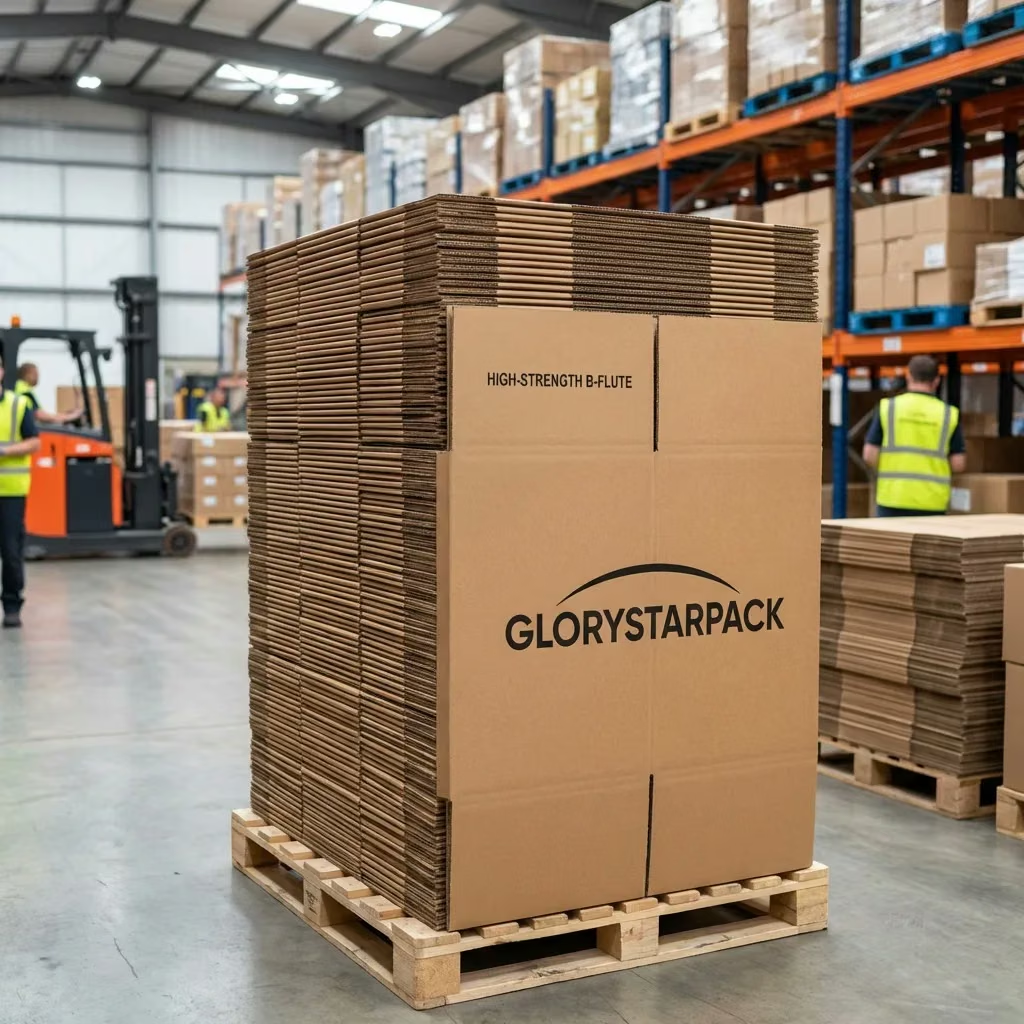
Carton and distribution
The master carton belongs in the tube specification.
Finished cylinders normally retain their volume and can roll, rub, point-load, or move inside a rectangular shipper. Ask suppliers to quote the sale-ready tube and the export pack together.
- Return unit outside diameter and overall closed height from the same sample used for carton planning
- State unit orientation, cells or dividers, surface protection, units per layer, layers, total units, void control, and carton gross weight
- Record finished carton outside dimensions, case count, shipping marks, pallet pattern, overhang policy, and maximum handling assumptions
- Inspect wrap rub, cap movement, crushed edges, out-of-round bodies, displaced ends, product movement, and carton damage after the defined route
- Use a current packaged-product test plan and pre-agreed damage criteria rather than treating the paper wall as proof of transit performance
Build the outer case and pallet brief · Review ISTA's design and testing overview
Contact and claims
Treat barriers, direct contact, and environmental language as separate workstreams.
A paperboard exterior does not establish barrier performance, food or cosmetic suitability, recyclability, recycled content, biodegradability, compostability, or an approved disposal route.
Name every contact layer
Define product chemistry or food type, direct or indirect contact, duration, temperature, moisture, oil, aroma, powder migration, liner, seal, ends, adhesives, inks, coatings, filling site, destination, and required documentation with qualified specialists.
Paper structure and product protection differ
If moisture, oxygen, aroma, oil, light, tamper evidence, or leak control matters, identify which component performs the function, how it is sealed, how it is verified, and what shelf-life or compatibility evidence belongs to the packed product.
Substantiate the defined package
The FTC advises qualifying recyclable claims when access is limited and qualifying partial recycled-content claims. Review every component and destination rather than calling a mixed tube universally eco-friendly. Read the FTC Green Guides summary.
Approval evidence
Move from fit model to production-equivalent packed sample.
A printed appearance sample and a hand-made white tube answer different questions. Define what each stage can approve and retain the released reference.
Scroll horizontally to view all columns →
| Gate | Check | Record |
|---|---|---|
| Product envelope | Maximum cross-section, height, weight, projection, orientation, tolerance, insert, loading and removal path. | Sample IDs, measurement method, drawing revision, photos, dimensions, approved assumptions and open risks. |
| Structural sample | ID, usable height, OD, closed height, body, cap, shoulder, ends, roundness, edges, engagement and loaded fit. | Measured results, cap and product force observations, fit combinations, defects, revision and approval limits. |
| Decorated sample | Wrap, seam, edge turns, copy, color, finish, register, lid orientation, rub, scuff, glue, odor and barcode. | Approved physical reference, artwork and dieline versions, signed change list, viewing and measurement conditions. |
| Packed-product test | Product, insert, closed tube, unit protection, master carton, conditioning, route hazards and failure criteria. | Procedure, samples, sequence, observations, damage, package degradation, deviations and disposition. |
| Production release | Critical dimensions, fit, appearance, materials, cleanliness, packing, identification, traceability and change control. | Inspection method, sample size, acceptance rules, retained samples, lot records, approved suppliers and notice process. |
Supplier-ready RFQ
Require every quote to return the same paper tube scope.
Separate buyer facts, supplier construction, evidence, commercial terms, packaging and change control so a lower unit price cannot hide a different usable space or shipment scope.
Scroll horizontally to view all columns →
| Section | Buyer states | Supplier returns |
|---|---|---|
| Product data | SKU, maximum loaded cross-section, height, weight, tolerance, orientation, sample or drawing, sensitivities. | Fit assumptions, controlled loading direction, proposed clearances, required sample and unresolved product data. |
| Finished size | Target ID, usable height, external limits, display or shipper constraints, measurement references. | Finished ID, usable height, body OD, maximum closed diameter, overall closed height, tolerance and method. |
| Construction | Telescopic, shoulder, end, insert, lift, grip, reclosure, contact, barrier and appearance needs. | Body, cap, shoulder, ends, wall, wrap, lining, insert, adhesive and material construction by component. |
| Evidence | Sample gates, dimensional, fit, opening, removal, contact, artwork, transit and acceptance requirements. | Sample route, measurement record, material documentation, test proposal, master sample and retained evidence. |
| Packing | Unit protection, carton limits, warehouse, parcel, pallet, route, handling and destination requirements. | Units per carton, orientation, divider, carton outside size, gross weight, carton count, pallet and freight scope. |
| Commercial | Quantity by size and artwork, target date, named Incoterm and place, inspection and compliance needs. | Tooling, samples, unit, inserts, assembly, decoration, packing, test, inspection, freight, exclusions and change terms. |
Paper tube sizing FAQ
Questions to settle before approving the cylinder.
The answers distinguish a useful planning calculation from the physical, regulatory, environmental, and distribution evidence still required.