Secondary paper packaging for glass fragrance bottles
Custom perfume boxes designed around the glass bottle.
Build fragrance packaging from the filled bottle's maximum envelope and weight through base and shoulder support, spray and cap clearance, surface protection, removal, brand coordination, and outer shipping.
Control every projection, finish, and weight-bearing surface.
Fragrance bottles often combine heavy glass, irregular shoulders, fitted caps, spray components, labels, coatings, and decorated faces. A product name or nominal volume is not enough to define the box.
Scroll horizontally to view all columns →
Perfume bottle inputs to record before box and insert sampling.
Control area
Information to provide
What it informs
Maximum envelope
Maximum length, width, height, filled weight, base and shoulder geometry, curvature, glass projections, and dimensional variation.
Internal clearance, cavity profile, support locations, board or box route, outer size, and whether an insert is required.
Top assembly
Spray head, pump, collar, neck, cap inside and outside profile, cap fit variation, removable components, and assembled height.
No-contact envelope, lid or tuck clearance, top restraint, packed orientation, and closing sequence.
Visible surfaces
High-gloss glass, coating, printing, label, metallic parts, seam positions, display face, and known scratch or mark concerns.
Permitted contact zones, lining and insert material, edge coverage, removal grip, and how movement is controlled.
SKU and set
Bottle and cap variants, fill size, sample or travel formats, accessory dimensions, quantity by SKU, and identification needs.
Shared versus unique structures, insert versions, artwork changes, gift-set spacing, carton assortment, and change control.
Fit rule: use a production-equivalent filled and fully assembled bottle for final fit review where practical. An empty or cap-free reference can misrepresent loaded behavior, overall height, center of mass, and the surfaces that reach the insert.
Base support and top clearance
Carry the bottle below; keep the spray assembly clear above.
The insert and box should manage the bottle's filled weight through approved structural zones. The pump, spray head, collar, cap, label, and decorated glass need documented clearance rather than accidental contact.
Support the base or lower body without loading an unstable punt, decorative foot, label edge, or fragile projection
Use approved body or shoulder zones to locate the bottle while allowing for glass and assembly variation
Define a no-contact envelope around the spray head, pump, collar, cap, and any loosely fitted decorative component
Check lid, tuck flap, accessory tray, insert movement, and stacking pressure against that top envelope
Inspect closing, handling, opening, removal, and replacement with the filled production-equivalent item
Hold the bottle where the customer can still lift it cleanly.
A tight cavity can create rub, finger pressure, cap pulling, or an awkward reveal. Retention and removal should be reviewed as one handling sequence.
Contact mapMark glass, coatings, labels, printed decoration, metallized surfaces, high-gloss faces, cap finishes, and seams as permitted, conditional, or no-contact zones.
Edge isolationCover or position cut edges, joints, hard cores, adhesive areas, and accessory components so they cannot reach visible bottle surfaces during transit or removal.
Movement controlUse the base, approved body or shoulder support, side pads, platforms, or separate cavities to limit movement without compressing the pump or cap.
Removal accessAdd finger recesses, side access, lift ribbons, removable platforms, or a controlled tray so the user lifts from the bottle body rather than the cap or spray assembly.
Material reviewSample proposed paper, board, fiber, foam, fabric, flock, adhesive, and seams with the actual surface for marks, abrasion, fiber transfer, odor, fit, and repeated removal.
Folding carton versus presentation box
Choose the structure from the bottle, channel, and opening.
Folding cartons and rigid formats solve different assembly, presentation, storage, and pack-out needs. Neither route removes the need for confirmed bottle clearance and loaded sampling.
Compact secondary pack
Folding carton
A folding carton can use flaps, paperboard partitions, or a separate insert around the bottle. Review board behavior under the filled weight, bottom and top closure, assembly, insert loading, cap clearance, and how the bottle is removed.
Structured presentation
Rigid or magnetic box
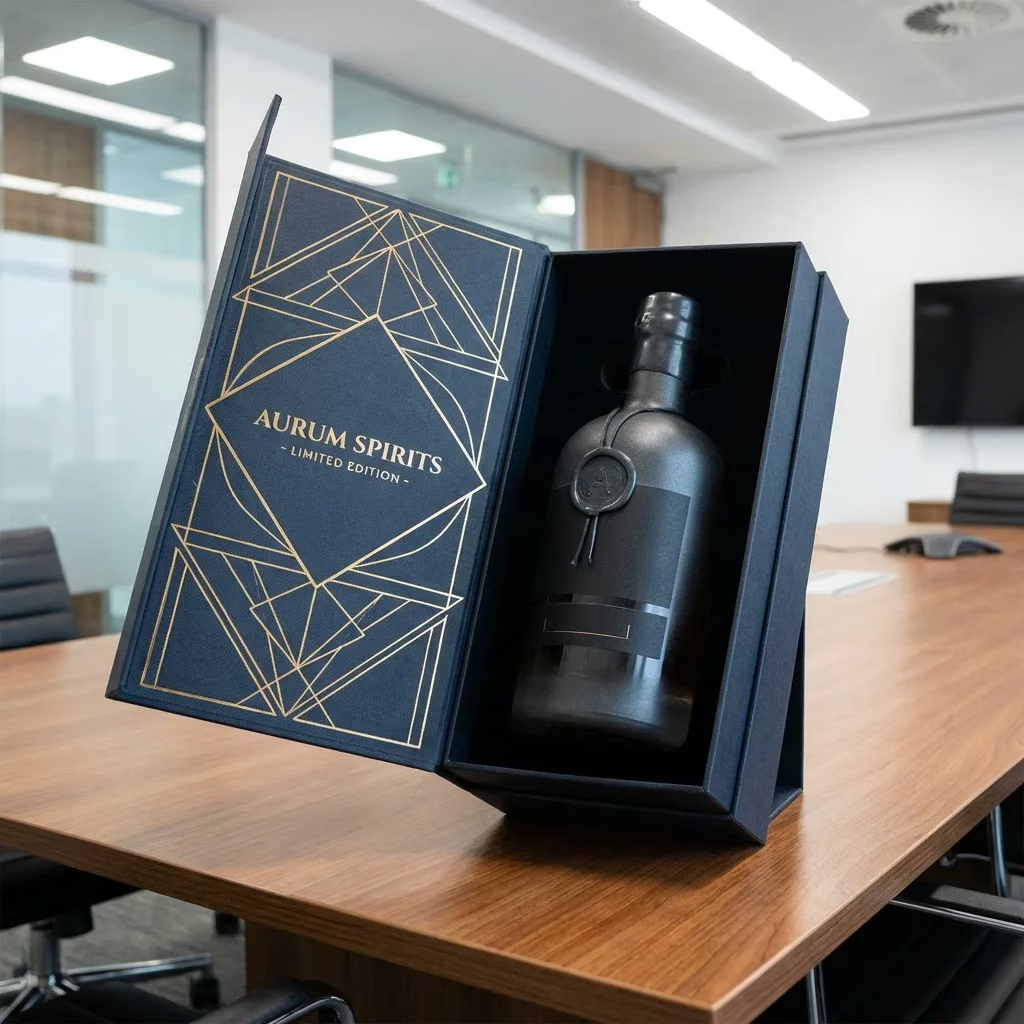
A custom rigid box supports a wider reveal and fitted interior; a magnetic box adds a hinged close. Specify loaded base behavior, insert seating, hinge and lid clearance, closure effort, and surface contact.
Round silhouette
Paper tube route
Custom paper tube packaging can suit selected cylindrical or compact bottle presentations. Confirm usable inside diameter, bottle anti-rotation, base support, cap and lid clearance, removal access, and stable outer-carton packing.
Applied folding-carton reference. Review tall blue perfume carton GS-1294765 for visible panel hierarchy and finish direction, then return to the real filled bottle for fit, support, surface, copy, and packing approval.
Box, label, and color coordination
Build one visual family with separate production controls.
A perfume range may coordinate bottle labels, folding cartons, rigid gift boxes, inserts, sample sizes, and set packaging. Shared references help the family look intentional, but each substrate, print route, finish, and viewing condition needs its own approved target.
Define master artwork rules for hierarchy, logo size, typography, finish zones, panel order, and required SKU identification
Set physical color references for the proposed box, label, insert, and wrap rather than treating one screen value as a universal result
Record which finishes must align across panels and which are independently positioned on separate components
Keep separate dielines, artwork files, material references, insert versions, and approval samples for every SKU or set format
Review the complete packed family under the brand's intended display and photography conditions
Keep a shared identity without forcing one internal fit.
A full-size bottle, travel spray, miniature, refill, cap variant, and accessory can share a visual system while requiring different support, clearance, removal, and identification.
PF–SET
Multi-item fragrance sets
Give every bottle and accessory its own controlled cavity, support zones, separation, top clearance, and removal path. Check the order in which items are revealed and removed.
Separate cavities
Set hierarchy
Loaded balance
PF–SKU
Coordinated size families
Share exterior proportions and artwork logic while controlling bottle envelope, cap clearance, insert, color reference, version code, and approval sample for each SKU.
Shared identity
SKU inserts
Version control
Sample and quality plan
Inspect the assembled bottle, box, and outer pack together.
Sampling, inspection, and packing decisions are confirmed after the bottle, SKU range, construction, materials, quantities, artwork, destination, and handling needs are documented.
01 · Define
Control product data
Record maximum dimensions, filled weight, top assembly, variation, decorated and no-contact zones, packed orientation, accessories, quantities, and destination.
02 · Prototype
Load the real construction
Review base and shoulder support, cap clearance, movement, insert seating, closing, surface contact, reveal, removal, replacement, and accessory separation.
03 · Approve
Set controlled references
Approve dielines, materials, physical color targets, finish position, loaded fit, workmanship criteria, artwork version, carton count, and identification.
04 · Inspect
Check SKU and pack-out
Verify dimensions, insert version, closure, bottle access, surface condition, print and finish placement, assortment, unit protection, carton labels, and outer packing.
Outer shipping and carton packing
The presentation box is secondary packaging, not automatically a shipper.
Heavy glass, projecting caps, delicate finishes, mixed SKU sets, and presentation surfaces all affect the outer pack. Develop the corrugated shipping box around representative loaded units.
Specify unit protection and dividers where box-to-box contact could mark wrap, print, foil, corners, lids, or closures
Choose loading orientation from bottle mass, cap clearance, insert retention, presentation-box structure, and opening direction
Control units per carton, layer pattern, void management, mixed-SKU rules, gross weight, dimensions, carton identification, and pallet needs if any
Review the complete representative pack for the intended handling and distribution route rather than making a universal transit claim
Buyer questions
Custom perfume box FAQ.
Final structure, contact material, support, color, sample, inspection, and shipping recommendations depend on the actual assembled bottle, quantities, destination, and pack-out.
Provide the filled bottle's maximum length, width, height, and weight; base and shoulder geometry; spray pump, collar, and cap dimensions; dimensional variation; label or decorated areas; sensitive surfaces; and intended packed orientation. Include quantity by SKU, artwork, delivery country, target date, accessories, and a production-equivalent item or controlled drawing for fit review.
The insert should carry the bottle at documented structural zones, typically starting with stable support under or around the base and additional location at approved body or shoulder areas. It should limit movement without pressing fragile projections, labels, high-gloss decoration, the spray assembly, or the cap. Confirm the loaded fit and removal with the production-equivalent bottle.
Clearance depends on the maximum assembled height, cap fit and variation, spray head and collar profile, packed orientation, lid or tuck path, and insert movement. Record the no-contact envelope above and around these components, then inspect a loaded sample through closing, handling, opening, and replacement rather than applying a generic allowance.
Map high-gloss glass, coatings, metallized parts, labels, printed decoration, and other visible faces before selecting contact materials. The insert can separate hard edges, cover approved contact zones, limit movement, and add removal access. Sample the proposed paper, board, fiber, foam, fabric, adhesive, seams, and finishes with the actual bottle for marking, abrasion, fiber transfer, and removal behavior.
A folding carton can provide a compact secondary pack with efficient flat-board construction, while a rigid box supports a more structured presentation and a wider opening sequence. Choose after reviewing bottle mass, insert needs, shelf and gifting context, assembly, product removal, outer dimensions, SKU range, and shipping pack-out. Both routes require a product-specific sample.
A coordinated family can share proportions, artwork rules, color targets, finish placement, and identification logic, but each bottle still needs controlled maximum dimensions, weight, cap clearance, insert fit, removal, and an approved sample. A gift set also needs defined spacing and separate support for every bottle and accessory.
A logo on a website is not enough. For a material, compliance, or quality requirement, request the current document and verify that its scope applies to your order.
Start with the assembled bottle, cap, and every visible surface.
Send product data, quantity by SKU, preferred structure, insert and removal direction, surface sensitivities, artwork and color references, gift-set layout, destination, target date, and outer-carton needs. We will use the brief to identify the structural and approval questions.